The Origins of the Sun and Moon : An Analysis of Cultural Variations
An analysis about the origins of the Sun and Moon based on cultural beliefs, folklore, and mythology
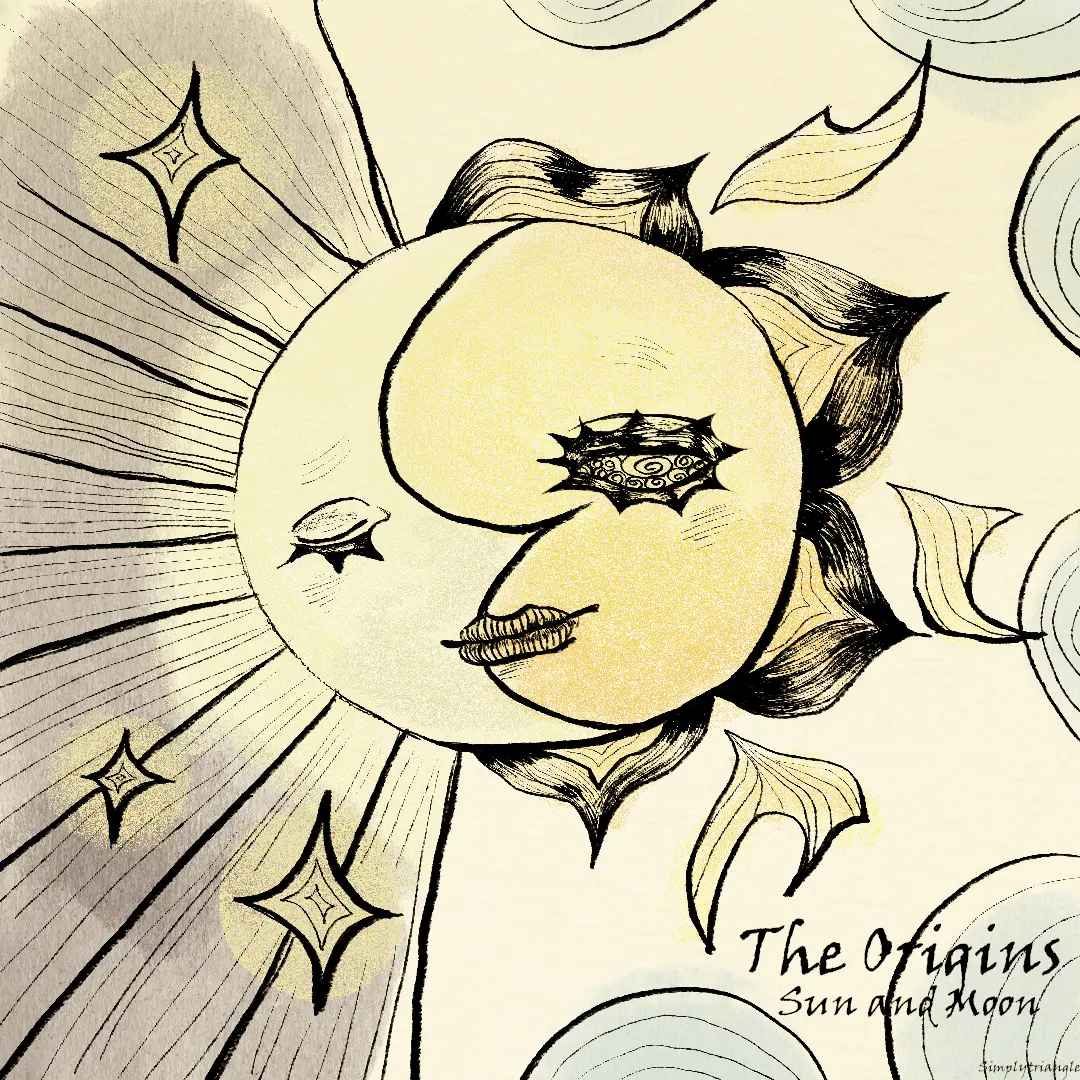
Introduction
Ever since I was a child, I’ve been fascinated by the Sun and the Moon—the way they each command the sky at different times of the day. Now that I’m older and curious, I want to understand the perspective of other people that see the sky the same way I do.
There are many variations of mythological stories regarding the origin of the Sun and Moon. A diversity of stories varying from different cultures that give their own explanation about the origins of the Sun and Moon; some focusing on why the Sun is shone brighter than the Moon. As a writer, these variations are such an interesting concept that I want to share it with you all.
Scientific Explanation.
Before that, let’s ground ourselves in fact first. Why does the sun dominate the day while the moon seems to belong only to the night? As it turns out, that’s a bit of a myth in itself. According to NASA, the moon actually spends nearly as much time in the daytime sky as the nighttime one — it just doesn’t announce itself the way the sun does. The moon produces no light of its own; it only reflects the sun’s. In the full glare of daylight, that reflected glow is simply no match for its source, and so the moon fades into the blue, easy to miss unless you know to look for it. The moon was never truly absent — it was only ever outshone.
The Deep Dive
While science explains the mechanics of the heavenly bodies, ancient Filipinos sought something different: meaning. Rather than asking how the sun and moon existed, many communities asked why they shone differently, disappeared, or took turns crossing the sky.
Buyser’s Interpretation
One interesting account comes from Rev. Fernando Buyser’s Mga Sugilanong Pilipinhon (1926), which preserves a Christianized interpretation of the Sun and Moon. According to the book “Mga Sugilanong Pilipinhon” written by Rev. Fernando Buyser in 1926 — Bathala created the moon, Bulan, and the sun, Adlaw, to illuminate the day and night; where the sun embodies the face of Jesus Christ and the moon embodies Mary that gives light to sinners.
Different Folk Variations
Furthermore, Damiana Eugenio’s book “Philippine Folk Literature : An Anthology” compiles these different story variations. These are the quick summaries of the three stories I picked from many tales :
In the Tagalog version, the Sun and Moon are two sisters — Araw and Buwan. Araw is kind and gentle, while Buwan is her opposite: difficult and disagreeable. Troubled by Buwan’s behavior, their fairy parent sought guidance from God, who had already prepared gifts for both girls. To test their character himself, God disguised himself as a beggar and visited them. Experiencing their natures firsthand, he rewarded Araw with a brilliant diamond. Buwan, furious at being passed over, broke into God’s palace and stole a jewel of her own — though hers shone far dimmer than her sister’s.
Angered by the theft, God sent two angels to punish Buwan. The angels, however, overstepped — and in their excess, punished both sisters, hurling them into the sea. As they fell, their jewels flew upward into the sky. Araw’s diamond became the Sun; Buwan’s stolen gem became the Moon. Even in the sky, the difference remains: one blazes, the other only glimmers.
Meanwhile, in the Manobo version, the Sun and Moon are not created due to jewels and punishments but two children that embody them. Apolaqui and Mayari, are the son and daughter of Bathala. From the eyes of his two children, the world received its first light. Their light brought joy to every creature, becoming great friends with the two children.
Bathala loved his children so much that he didn’t want to be away from them, always accompanying them on their daily walks. But as time went on, Bathala grew old and feeble and couldn’t accompany his children anymore as they grew active. He asked them to stay by his side at all times — however his children are caught up in their own pleasures and paid no heed to his wishes. When he died due to old age his kingdom had no ruler and thus Apolaqui and Mayari were caught in a conflict. Apolaqui wanted to rule the kingdom by himself, but Mayari refused. They fought with bamboo poles, and Apolaqui struck his sister’s eye. Feeling guilty, he relented. The Sun will rule the day, and the Moon will rule the night. Both shine but the Moon is dimmer due to the eye Mayari’s had lost during the fight.
In the Mandaya and Mindanao version, both the Sun and Moon are married. The Sun is ugly and quarrelsome, and when he directed his anger to his wife — the Moon fled, putting enough distance between them. When the Moon grew tired, the Sun almost caught up; thus repeating the cycle of day and night.
Their first child was a large star, when the Sun became angry he cut his son into pieces and scattered every piece into the sky.
Their other child was a giant crab called Tambanokano. Tambanokano is a very powerful being that lives in the depths of the ocean. However, Tambanokano inherited his father’s characteristics. One day he got angry at his mother, the Moon, he tried to swallow her up. The people that are fond of the moon saw this, they rushed in to save her by shouting and beating gongs that terrified Tambanokano.
Interpretation
These story variations are an interesting read and leave a lot of room for questions.
What is the trigger for these variations? Is it the culture, the environment, oral traditions or other reasons? What are the things that influenced these variations? Moreover, there are religious versions too like Reverend Buyser’s story — allowing me to interpret that religious beliefs has an influence in the origins of an object, concept, or an entity.
An example is the moon-eating event or the origin of the eclipse. For those who know the Hiligaynon tale of the Bakunawa, it is a mythological creature that wants to devour the seven moons. Comparing it to the Mindanao and Mandaya version, I found it interesting that one uses a large dragon-like serpent while the other is a powerful gigantic crab. Why specifically a crab? Why a serpent? What does the Tambanokano mean? Does its connection to the Moon and Sun symbolize something else excluding eclipses? If there are Bakunawa, Tambanokano, and Minokawa, are there any more creatures that eat heavenly bodies? These are something I want to take note of in case I find more information.
While there are many story variations, searching for the “correct” origin of the Sun and Moon is futile. These stories remind us that folklore reflects the beliefs, values, environments, and histories of the communities that created and preserved them. Though times are changing, it is noticeable that the folktale has become a foundation for the emergence of new folktales. These differences are not contradictions—they are evidence of the Philippines’ remarkable cultural diversity.
Writer’s Reflection
These stories are a treat from a writer’s perspective. Why do you ask? By researching a variety of origins of an object, concept, entities, etc. we can gain a proper inspiration that is still grounded to reality and culture. By doing this, we learn culture for what they have to offer and carry those messages as a story for the current era and the next generations.
References:
-
Buyser, F. A. (1926). Folk lore filipino: Mga sugilanong pilipinhon. Philippine Church Printing.
-
National Aeronautics and Space Administration. (n.d.). Why can you see the moon during the day? We asked a NASA scientist: Episode 19. NASA. https://www.nasa.gov/solar-system/why-can-you-see-the-moon-during-the-day-we-asked-a-nasa-scientist-episode-19/
-
Eugenio, D. L. (1985). Philippine folk literature: An anthology. University of the Philippines Press.